







Does regulating fuel prices automatically shield consumers from price shocks?
New research with a policy brief published by the Center for Economic Analyses (CEA) in Skopje, authored by Youssef Lamrani Laghrib under the mentorship of CEA, analyses 16 years of monthly data (2010–2025) to answer this question. The study compares North Macedonia and Morocco – two net oil-importing economies with vastly different price-setting mechanisms and exchange rate regimes.
The findings challenge traditional economic assumptions.
Key Findings: The Reversal of Expectations
Economic intuition suggests that liberalized markets transmit price shocks rapidly, while regulated systems buffer them. However, the study reveals a inverted reality:
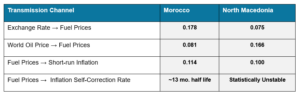
- The Exchange Rate Channel Operates as Expected: Morocco’s more flexible exchange rate regime transmits about 2.4 times more exchange rate volatility to retail fuel prices (0.178) compared to North Macedonia’s euro-pegged denar (0.075).
- The Crude Oil Price Channel Operates in Reverse: North Macedonia’s regulated formula transmits crude oil price movements nearly twice as strongly (0.166) to retail fuel prices as Morocco’s deregulated market (0.081).
- Regulator’s Mechanism Lacks a Buffer: North Macedonia’s weekly price adjustment formula by the Energy and Water Services Regulatory Commission (RKE) binds domestic prices directly to global benchmark quotations and fixed regulatory margins. In Morocco, private distributors dynamically adjust short-run profit margins, temporarily buffering initial global price spikes for consumers.
- The Euro Peg Does Not Eliminate Dollar Risk: Although the Macedonian denar is pegged to the euro, oil imports are invoiced in US dollars. Data shows that the MKD/USD exchange rate exhibits higher variability (9.03% coefficient of variation) than the MAD/USD rate in Morocco (7.62%).
- Uncertain Inflation Mean-Reversion: In Morocco, inflation following an oil shock returns halfway toward its long-run equilibrium roughly every 13 months. In North Macedonia, the adjustment process of overall consumer prices is statistically unstable, indicating that domestic inflation lacks a reliable self-correcting mechanism once disrupted.
Statistical Overview of Price Transmission
Policy Recommendations
For North Macedonia:
- Introduce Smoothing Mechanisms into the RKE Formula: Incorporate for instance a 4-to-6-week rolling average for international benchmark prices and the USD exchange rate, combined with a cap on maximum weekly price adjustments, to prevent abrupt spikes.
- Actively Monitor USD Volatility: The euro peg stabilizes European trade but does not shield energy imports priced in US dollars.
- Do Not Rely Solely on Monetary Tightening: Changes in the central bank’s policy rate showed no statistically significant impact on mitigating oil-driven inflation. The primary tool for managing supply-side energy shocks must be the pricing framework itself.
For Morocco:
- Monitor Distributor Margins Directly: Informal buffering through private profit margins is cost-effective for public budgets but risks failing under prolonged high global price environments.
- Maintain Focus on Exchange Rates: Because the exchange rate is the dominant pass-through channel in Morocco, currency management by Bank Al-Maghrib remains critical to controlling imported inflation.
About the Research: The full study is available here “Two Roads from Brent to the Basket: Oil Price Pass-Through in Morocco and North Macedonia”, authored by Youssef Lamrani Laghrib during his research internship at the Center for Economic Analyses (CEA) in Skopje.
This policy brief may also be accesed here: “Two Roads from Brent to the Basket”